

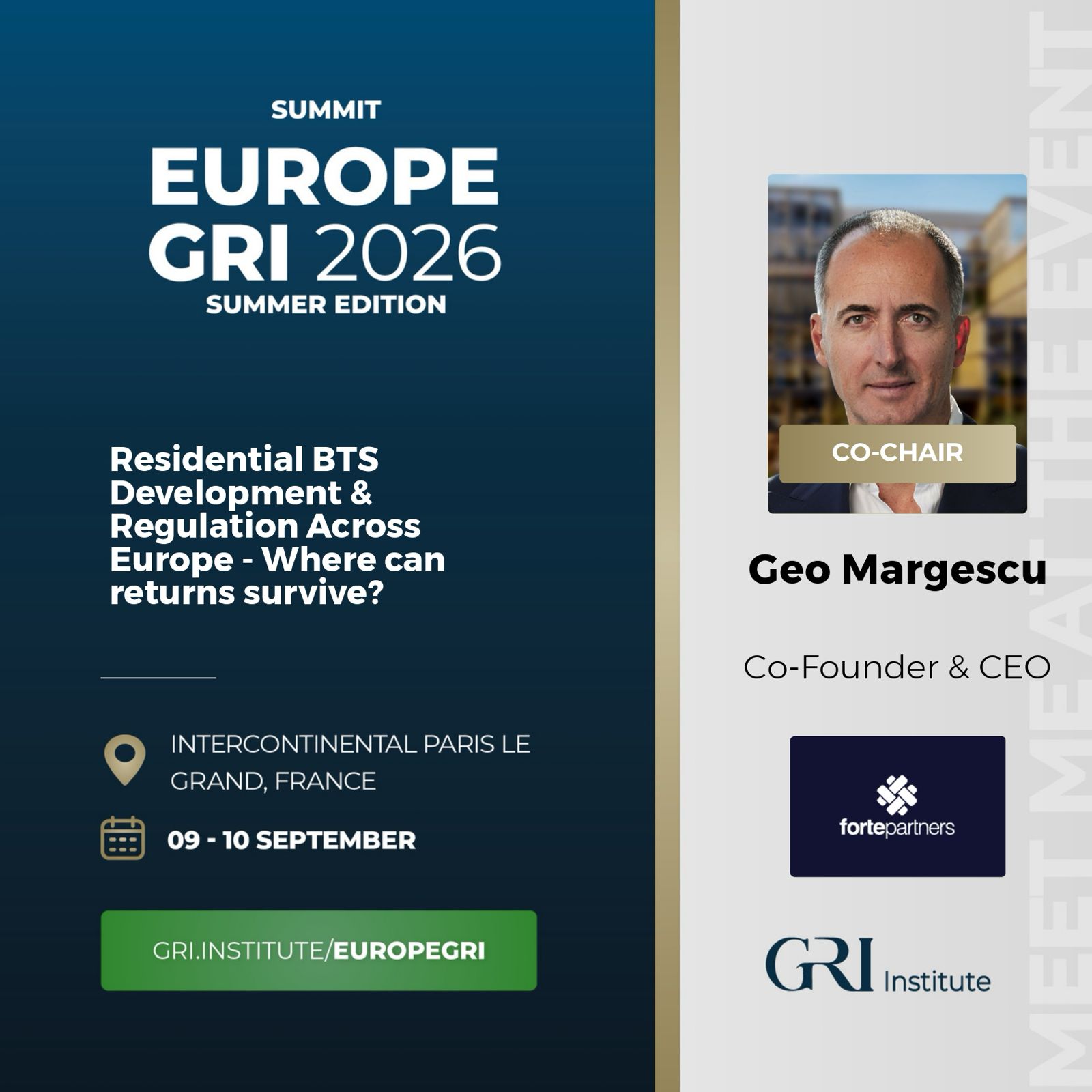
At a time when residential developers across Europe are navigating rising construction costs, evolving regulations and a more selective investment environment, one question is increasingly shaping industry discussions. What makes residential development viable today?
This was the central themeof the panel “Residential BTS Development & Regulation AcrossEurope - Where Can Returns Survive?” at Europe GRI 2026 in Paris, where Geo Mărgescu, Co-Founder and CEO of Forte Partners, joined leading industry professionals to discuss the future of residential development across the continent.
While market conditions differ from one country to another, the debate highlighted a common reality. The projects that continue to perform are those built on strong fundamentals rather than short-term market momentum.
Returnsare increasingly driven by quality
Across Europe, residential markets are becoming more sophisticated and buyers more discerning. In this context, quality is no longer a differentiator, but an expectation.
Today’s buyers evaluate a much broader set of criteria than they did a decade ago. Beyond price, they look at construction standards, energy efficiency, access to amenities, mobility options and the long-term attractiveness of the neighbourhood. As a result, projects that succeed in addressing these needs are better positioned to maintain demand and preserve value over time.
This shift is changing howdevelopers approach residential projects. The focus is moving away from maximizing density or responding to short-term demand cycles and toward creating places that remain relevant for years to come.
Location remains the strongest driver of long-term value
One of the key themes emerging from the discussion was the growing importance of urban integration.
Location has always been fundamental in residential development, but its meaning has evolved. Today, a desirable location is defined not only by proximity to the city centre, but also by connectivity, access to public transportation, quality public spaces and the availability of services that support everyday life.
As cities continue to grow and adapt, developments that are well connected to existing urban infrastructure are demonstrating greater resilience. They tend to attract sustained buyer interest and support stronger long-term value creation for both residents and investors.
From this perspective, residential projects should be viewed as part of a larger urban ecosystem rather than as isolated real estate products.
Capitalis still available, but increasingly selective
Despite ongoing economic uncertainty, investor interest in residential real estate remains strong across many European markets.
However, capital is becoming more selective. Investors and lenders are paying closer attention to project fundamentals, execution capabilities and long-term market positioning. The ability to deliver a product that responds to genuine market needs has become just as important as financial modelling.
This creates a more disciplined environment for developers, but also a healthier one. Projects that combine a strong location, quality design and a clear understanding of future demand continue to attract interest even during challenging market conditions.
In this respect, viability is no longer determined solely by costs, financing conditions or market cycles. It is increasingly linked to the quality and relevance of the product itself.
Building value beyond the sales cycle
Perhaps the most important conclusion of the conversation in Paris was that successful residential development requires a long-term perspective.
The developments that create lasting value are those that contribute positively to the city, enhance the quality of life of their residents and remain desirable long after construction is completed. As expectations continue to evolve, developers must think beyond the immediate sales cycle and focus on the long-term performance of the communities they create.
Speaking at Europe GRI 2026, Geo Mărgescu emphasized a reality that is becoming increasingly visible across European markets. Sustainable returns are not generated by market growth alone. They are created through quality, thoughtful urban integration and the ability to develop places that can build communities stand the test of time.